This is the first note in a ledger I am keeping for our household. I am not a financial advisor. I built a calculator so the rules are visible, and I am publishing both here so Lisa and I cannot quietly rewrite them in a panic.
If you have heard only one retirement rule, it is the 4% rule: take about four percent of the pile in year one, raise the check with inflation, hope it lasts thirty years. That is a useful starting point. It is not a paycheck.
A paycheck has to survive a crash in year two. It has to pay this mortgage and this grocery bill without a debate every March. And it has to leave the long-term money invested, because if I stop drawing a salary at 55 we may need that money for 35 years.
I am 51. The written family plan still targets work through 2032 — age 58 — unless a concentrated private-stock position turns into after-tax cash earlier. The number I treat as the early-retire landing zone is about $2.75 million after tax around 2030. The month I am willing to run the house on is $12,000 in 2026 dollars, $144,000 a year. Helping the kids and the house payment are already inside that month. They are not extras.
The calculator starts there. The rest of this note is why the glasses are arranged the way they are.
The picture
Think of three glasses of water, not one big brokerage number.

- Cash is the tap. Groceries, the house payment, insurance, travel — all of it comes out of this glass. We keep about two years of household costs here.
- Bonds are the reserve tank. About eight years of household costs. Boring on purpose. Their job is to refill cash when stocks are down.
- Stocks are the well. They grow for decades. We do not pay the electric bill by selling the well in a panic.
That picture is not original. Planners have called it a bucket strategy or a cash reserve since Harold Evensky described a cash-versus-everything-else split in the 1980s. Christine Benz at Morningstar popularized the three-bucket version. What I added is a calendar and a few hard rules about when water is allowed to move.
Why the well cannot be the tap
On $2.75 million and a $144,000 month, the first years are not gentle. Before Medicare we may buy our own health insurance — call it $36,000 in today’s dollars — unless a job or shop coverage is still carrying us. Social Security has not started. Add tax on money leaving taxable accounts and the first portfolio withdrawal can sit in the $200,000 range.
Now suppose stocks fall 25% in year two. If the whole pile was one “balanced” account and we sold a slice of everything, we would be selling stocks after they already got cheaper. Do that two or three years in a row and the well never recovers. Researchers call that sequence-of-returns risk. You can have a fine average return over thirty years and still get hurt because the bad years arrived first.
Cash and bonds exist so year two’s grocery bill does not require a sale of stocks at the bottom.
The December rule
We do not look at this year’s market and then invent this year’s lifestyle. That is how households start fighting in March.
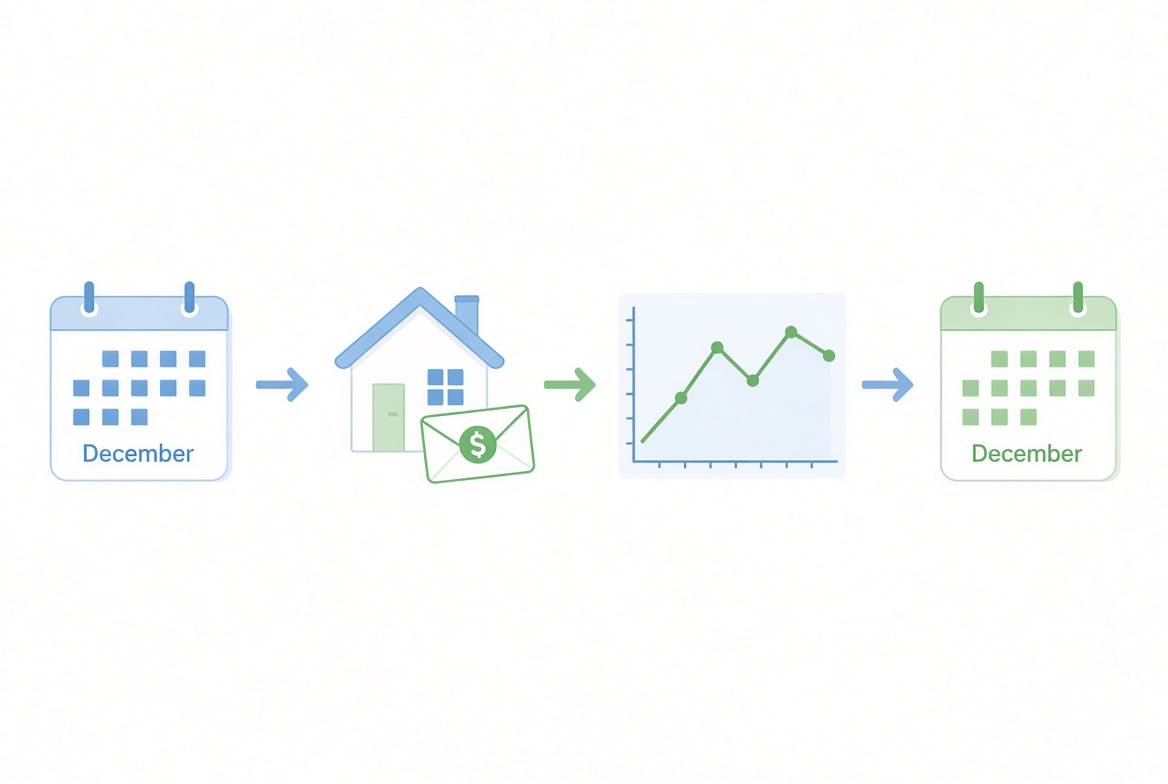
Each December we write next year’s paycheck.
- Spend the number already on the calendar.
- After the year is over, look at how stocks did.
- Write next year’s number.
A strong stock year can raise next year’s lifestyle a little. A down stock year can cut next year’s lifestyle a little. A second down year in a row does not cut again. We hold the line. We call that a plateau.
| Year | What last December decided | What stocks did this year | What that means |
|---|---|---|---|
| First year | Planned $144,000 | A great year | We still spend $144,000. The raise waits. |
| Second year | Raise, about $154,000 | A bad year | We still spend the raise. Travel is not yanked mid-year. |
| Third year | Cut, about $136,000 | Whatever happens next | Last year’s crash finally shows up in the paycheck. |
The lag is the point. The household gets a year to adjust. The market does not get to re-trade Christmas.
We also keep the year inside a band: 75% to 125% of the planned lifestyle. On $144,000 that is $108,000 to $180,000. A bull market does not talk us into $220,000. A crash does not talk us into $80,000 while the house still costs what it costs.
That band is a cousin of Guyton–Klinger guardrails. Their version watches the withdrawal rate — spending as a percent of the current pile. Ours watches the lifestyle we told ourselves we need. Different trigger, same idea: decide the raises and cuts in advance so you are not improvising.
How the glasses refill
The tap only draws from cash. In an up year for stocks we may pour this year’s gain into cash until cash is back to two years of costs. Leftover gains can top up bonds. If cash is still short, bonds finish the job. We do not sell stock principal just to restock the tap.
In a down year the well is locked. Bonds refill cash. That is what the eight-year reserve is for.
If cash or bonds grow past their targets — which happens when Social Security starts, or when the mortgage dies in 2040 — the extra goes back into stocks. A paid-off house should not leave us sitting on idle cash.
We also keep a minimum in stocks so the well cannot be emptied by a decade of refills: 30% before 75, 20% from 75 to 84, 10% after that. If a crash drops stocks under the line, bonds buy them back. Cash that pays next year’s bills does not do that job.
The month gets cheaper when life gets cheaper
The $144,000 already includes helping our four kids and paying the house. When a slice of the month ends, the requirement falls. Kid help can drop off after a chosen year. The mortgage, on the extra-pay schedule we are on, ends in September 2040 — about $42,600 a year leaves the requirement the following year. We do not automatically spend the savings.
Health insurance before Medicare is the one extra. It sits on top of the $144,000 and only in the years we actually pay it. If a job or shop coverage is still carrying us, the gap starts later. After 65, ordinary medical costs live inside the month. There is no separate Medicare rider.
I plan to claim Social Security at 70. Lisa may claim at 62. Those checks do not raise the lifestyle by themselves. They replace part of what we were taking from the portfolio.
Draw start is not “quit everything.” The calculator lets a paycheck sit next to the first withdrawal. That is the chapter I may actually live: start the tape, keep some income, buy time for the concentrated stock to become cash.
What this is, and what it is not
There is no official product named after this calculator. The honest sentence is: a three-bucket cash-reserve plan with spending guardrails and an optional later-life fade. The December calendar, the gains-only refill, the age-based stock floor, and the slices that fall off the month are household operating rules on top of that.
A careful advisor will push back, and they should. Two years of cash plus eight years of bonds is a large bet on low-return paper. Lifestyle collars protect the travel years and accept a worse ruin profile than rate-based guardrails. The December lag spends into a crash. The first-decade withdrawal on $2.75 million at 55 is still high. 7.5% real equity is an assumption, not a promise. Tax in the model is a sketch.
If those holes bother you, good. The point of publishing the rules is so we cannot hide from them. The only number that makes the glasses work is the one we actually have after tax, in accounts we can spend, on the day the paycheck stops.